
 Directions
 Facebook
 X
X Instagram
 YouTube
 Japanese
 Contact Us
Virtual Fugaku
JapaneseWhat is “Virtual Fugaku”?
"Virtual Fugaku" is the new platform strategy from R-CCS that reproduces a very rich software environment equivalent to "Fugaku" on a supercomputer or cloud service other than "Fugaku."
“Fugaku” continues to achieve great results not only because of its superior hardware but also because we have spent time developing various software from the design stage, providing an easy-to-use environment for users. If the many software that has already been developed and built for "Fugaku" can be packaged and installed on a computer we normally use with a single touch, an instant "Fugaku" can be created. If we were able to immediately reproduce the research platform that supports world-class research in our own hands, the progress of science and technology would take a further leap forward.
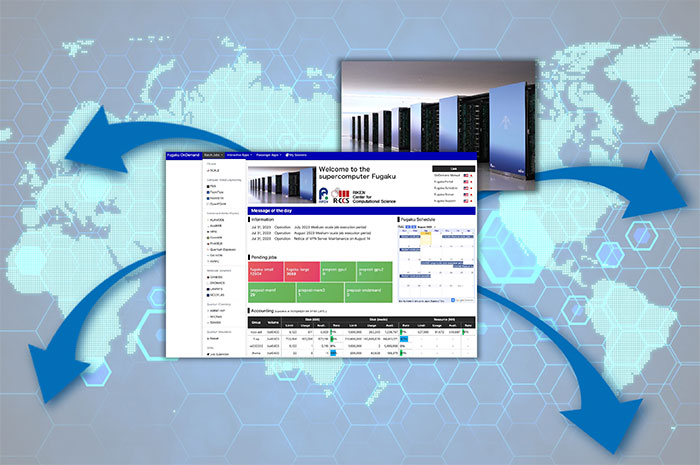
To realize "Virtual Fugaku," R-CCS is building a software stack that can develop and execute various applications as a de facto standard for HPC software. If supercomputer centers around the world adopt this standard software stack, and an application is developed on "Fugaku" or "Virtual Fugaku", the same application will be available at any supercomputer center. This is a revolutionary platform strategy. Virtual Fugaku" is like iOS, Android, or Windows OS for supercomputers, allowing the same app to be used on any device, including smartphones, tablets, and PCs. By searching in the app store, you can find a variety of applications and install them with just one touch. "Virtual Fugaku" will make this kind of world possible with supercomputers.
Why are we working on creating “Virtual Fugaku”?
Since “Fugaku” began its official operation in March 2021, “Fugaku” has not only produced numerous scientific results but also greatly contributed to solving social issues. “Fugaku" has been evaluated by many users as an "easy-to-use supercomputer," and the number of users has been increasing greatly, leading to intensifying competition for its use. To make more effective use of the value of "Fugaku," we are trying to provide users with a new option called "Virtual Fugaku. Up until now, a lot of effort and time has been required to become familiar with supercomputers with their environment and to be able to use them effectively. Even if we had learned it, we would have to learn it all over again to use a different supercomputer, which causes an inconvenience. In addition, the provider of the supercomputer also had to re-invent the software environment from scratch every time the system was updated, which required a great deal of effort and investment. “Virtual Fugaku" enables users of all supercomputer systems to develop and use applications in a common and rich environment and is an effort to solve the long-standing problems of supercomputers mentioned above. There will probably be situations where "Virtual Fugaku" is more advantageous than "Fugaku" in terms of freedom, confidentiality, computing power, etc. By utilizing "Fugaku" and "Virtual Fugaku" for different purposes, we expect greater convenience, especially for supercomputer users in the industry, as there will be a wider range of options than ever before.
Current Situation
To build such "Virtual Fugaku," R-CCS first concluded a memorandum of understanding with Amazon Web Services (AWS), which provides cloud services using AWS Graviton, a CPU based on the Arm architecture compatible with the CPU of "Fugaku," then R-CCS and AWS collaborated on research aimed at building a software environment in which functions of “Fugaku” can be virtually reproduced on the cloud, allowing applications on “Fugaku” to run almost exactly as they are on AWS. Based on the results of the research cooperation, R-CCS chose the Graviton CPU as the first supported target for "Virtual Fugaku" and released version 1.0 in August 2024. Since then, it has been continuously enhancing Virtual Fugaku. The software stack for “Virtual Fugaku” is a curated selection of open-source software commonly used in the latest operations of Fugaku.
The distribution will be done by Singularity container image. Those who have purchased AWS instances will be able to build their own private "Fugaku" by installing this container image on AWS. In addition, a "Virtual Fugaku" test and trial environment will be provided on AWS cloud service, which can be used by any user of "Fugaku."

In future
“Virtual Fugaku" will be maintained as a sustainable software environment by continually revising its configuration as the current system, Fugaku, evolves. And please help us enhance the software configuration of "Virtual Fugaku" by using container images and test environments. In the future, we plan to support architectures other than Arm architecture by applying "Virtual Fugaku" to the systems planned to be installed in R-CCS.
Video

Related Link
Contact Us
 virtual-fugaku [at] ml.riken.jp
- Please replace [at] with @ when sending an email.