
 Directions
 Facebook
 X
X Instagram
 YouTube
 Japanese
 Contact Us
TOP
 Research
 Teams for Science of Computing and Science by Computing
Complex Phenomena Unified Simulation Research Team
Research
Research Teams for Science of Computing and Science by Computing
Complex Phenomena Unified Simulation Research Team
Complex Phenomena Unified Simulation Research Team
Japanese
Team Principal Makoto TSUBOKURA
 mtsubo[at]riken.jp (Lab location: Kobe)
- Please change [at] to @
- 2015
- Professor, Graduate School of System Informatics, Kobe University (-present)
- 2012
- Team Leader, Complex Phenomena Unified Simulation Research Team, AICS (renamed R-CCS in 2018), RIKEN (-present)
- 2007
- Associate Professor, Faculty of Engineering, Hokkaido University
- 2002
- Associate Professor, University of Electro-Communications
- 1999
- Lecturer, Interdisciplinary Graduate School of Science and Engineering, Tokyo Institute of Technology
- 1997
- Post Doctoral Researcher, JSPS
- 1997
- Ph.D, Faculty of Engineering, The University of Tokyo
Keyword
- Fluid Dynamics
- Turbulence
- Computational Fluid Dynamics
- Vehicle Aerodynamics
- Large Eddy Simulation
Research summary
In manufacturing industries, there is a strong demand for simulations of complex, coupled phenomena (multi-physics phenomena) in which flow, heat, structure, acoustics, chemical reactions, and other processes interact with one another. Traditionally, such problems have been tackled by combining numerical methods that were independently developed for each individual phenomenon. However, when one attempts to further increase the speed and accuracy of simulations by exploiting large-scale HPC environments such as the supercomputer Fugaku, data transfer and interpolation between different solvers become bottlenecks, making it difficult to fully exploit the computational performance that the hardware can, in principle, provide.
Our laboratory sets as its overarching goal the development of simulation technologies for complex, coupled phenomena on HPC platforms, the advanced utilization of HPC environments through integration with AI technologies, and the deployment of these technologies to industry. To this end, we are conducting research and development centered on CUBE, an integrated simulation framework based on a unified data structure. Specifically, we are working on:
(1) Realizing real-time simulation by further accelerating numerical methods for next-generation computer architectures, typified by CPU/GPU hybrid systems, spanning from Fugaku to its successor FugakuNext, and by building real-time simulation infrastructures using machine-learning-based surrogate models, CNN-based reduced-order models, PINNs, and related techniques;
(2) Realizing high-accuracy prediction under actual operating conditions (real-world simulation) that is difficult to reproduce in experiments;
(3) Building next-generation digital engineering technologies, including the construction of a multi-objective optimization framework based on the integration of CFD and AI, and the proposal of optimal shapes using generative AI technologies;
(4) Developing algorithms for solving partial differential equations on quantum computers.
Through these activities, we aim to further expand the potential of simulation in the manufacturing domain.
Selected awards:
- November 2021: ACM (Association for Computing Machinery) Gordon Bell Special Prize for High Performance Computing-Based COVID-19 Research
- April 2022: The Commendation for Science and Technology by the Minister of Education, Culture, Sports, Science and Technology (Science and Technology Promotion Category)
- February 2023: Cabinet Office, Government of Japan – 5th Japan Open Innovation Prize (Minister of Education, Culture, Sports, Science and Technology Award)
- September 2023: 2023 JACM (Japan Association of Computational Mechanics) Computational Mechanics Award
Main research results
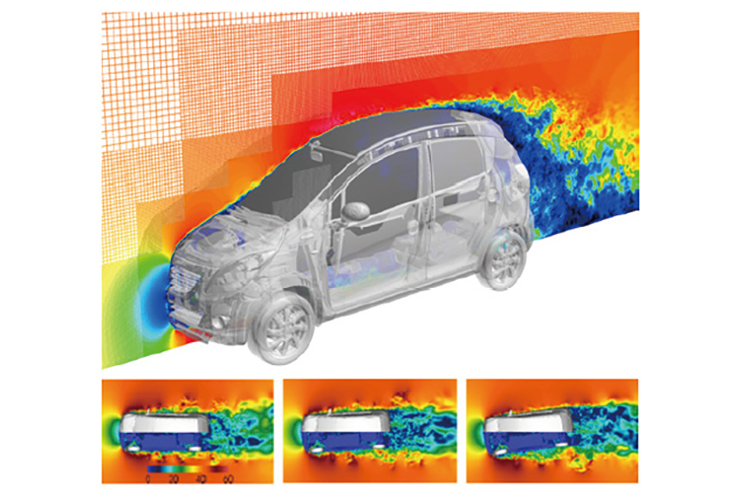
Simulation of a Vehicle’s Coupled Aerodynamics and 6DoF-Motion in Real Driving Conditions
By developing a new hybrid Euler-Lagrangean moving boundary method for the immersed boundary technique, and implementing it in the CUBE unified simulation framework, we have made it possible to simulate vehicular aerodynamics coupled with 6DoF motion. We successfully conducted a real-world simulation of a vehicle in cornering conditions. To achieve this, we used both detailed and dirty CAD data (provided by an automotive OEM) and the wheel rotation together with the front wheels’ steering angle-change in order to reproduce the vehicle’s complicated shape. This innovative simulation makes it possible to evaluate high-speed drivability from CAD data only. This presents new manufacturing possibilities for vehicle makers by means of optimizing a vehicle’s total performance in an integrated manner at an early stage of development before real prototyping begins.
Representative papers
- Atsushi Tajima, Takumi Hirata, Jun Ikeda, Kosuke Nakasato, Takahiro Kamiwaki, Junichi Wakamatsu, Munehiko Oshima, Makoto Tsubokura:
"Main Factors that Modulate Vehicle Wind Noise and Measures to Reduce It."
Journal of Wind Engineering and Industrial Aerodynamics, vol.266, pp.106210, https://doi.org/10.1016/j.jweia.2025.106210 (2025) - Koji Nishiguchi, Tokimasa Shimada, Christian Peco, Keito Kondo, Shigenobu Okazawa, Makoto Tsubokura:
"Eulerian finite volume method using Larrangian markers with reference map for incompressible fluid-structure interaction problems"
Computers & Fluids, vol. 274, 106210, https://doi.org/10.1016/j.compfluid.2024.106210 (2024) - Aito Higashida, Kazuto Ando, Mario Ruttgers, Andreas Lintermann, Makoto Tsubokura:
"Robustness evaluation of large-scale machine learning-based reduced order models for reproducing flow fields"
Future Generation Computer Systems, vol.159, pp.243-254, https://doi.org/10.1016/j.future.2024.05.005 (2024). - Kazuto Ando, Keiji Onishi, Rahul Bale, Akiyoshi Kuroda, Makoto Tsubokura:
"Nonlinear Reduced-Order Modeling for Three-Dimensional Turbulent Flow by Large-Scale Machine Learning"
Computers and Fluids, 106047, https://doi.org/10.1016/j.compfluid.2023.106047 (2023) - Rahul Bale, ChungGang Li, Hajime Fukudome, Saori Yumino, Akiyoshi Iida, Makoto Tsubokura:
"Characterizing infection risk in a restaurant environment due to airborne diseases using discrete droplet dispersion simulation"
Heliyon, 9(10), e20540, https://doi.org/10.1016/j.heliyon.2023.e20540 (2023) - Kazuto Ando, Rahul Bale, ChungGang Li, Satoshi Matsuoka, Keiji Onishi, Makoto Tsubokura (alphabetical order by surname):
(2021 ACM Gordon Bell Special Prize for High Performance Computing-Based COVID-19 Research awardee) "Digital Transformation of Droplet/Aerosol Infection Risk Assessment Realized on “Fugaku” for the Fight against COVID-19"
International Journal of High Performance Computing Applications, vol.36, No.5-6, pp.568-586, DOI: 10.1177/1094320221116056 (2022) - Rahul Bale, Akiyoshi Iida, Masashi Yamakawa, ChungGang Li, Makoto Tsubokura:
"Qantifying the COVID 19 infection risk due to droplet/aerosol inhalation"
Scientific Reports, Vol.12, 11186, DOI: 10.1038/s41598-022-14862-y (2022) - Rahul Bale, Amneet Pal Singh Bhalla, Boyce E. Griffith, Makoto Tsubokura:
“A one-sided direct forcing immersed boundary method using moving least squares”
Journal of Computational Physics, vol.440, 110359, DOI: 10.1016/j.jcp.2021.110359 (2021) - Koji Nishiguchi, Rahul Bale, Shigenobu Okazawa, Makoto Tsubokura:
"Full Eulerian Deformable Solid-Fluid Interaction Scheme Based on Building-Cube Method for Large-Scale Parallel Computing"
Journal for Numerical Methods in Engineering, vol.117, no.2 (2019), DOI:10.1002/nme.5954, pp.221-248 - Niclas Jansson, Rahul Bale, Keiji Onishi, Makoto Tsubokura:
"CUBE: A scalable framework for large-scale industrial simulations"
International Journal of High Performance Computing Applications,vol.33, No.4, pp.678-698, DOI: 10.1177/1094342018816377(2018)

